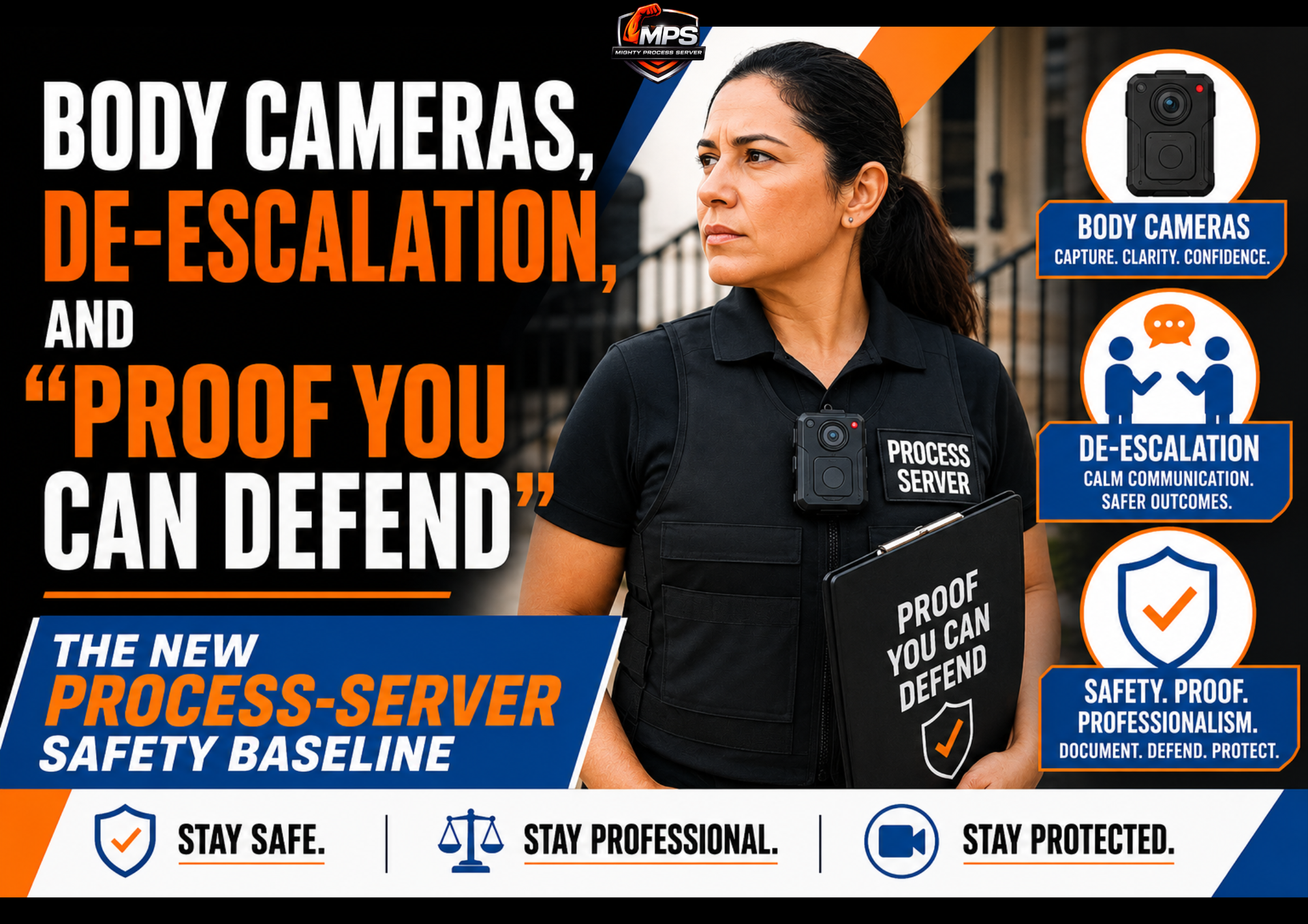
Build a “Recording-Ready” Safety Protocol (and Use the Law as Your Shield)

This week’s safety focus is about documenting risk and lowering exposure—especially when parties become hostile at the door. We revisit the federal crime of obstructing or assaulting someone authorized to serve federal process and translate it into practical field checklists. We also spotlight why “recording-ready” operations (body cams, phone video, and incident logs) are becoming standard operating procedure.
Every process server knows the truth: the job can go from routine to volatile in seconds. The best safety programs don’t rely on “being tough”—they rely on preparation, documentation, and controlled escalation.
Start with the legal framing. Under federal law, assaulting or obstructing a person “duly authorized” to serve federal process is a crime. That doesn’t stop bad behavior, but it changes how you document and report it. If you ever end up in a police report, a court declaration, or a client escalation, you want your narrative to be clear: you were on lawful business, you attempted service professionally, and the hostility came from the recipient.
A practical safety stack (low-cost to high-impact):
Pre-approach assessment: park for a clean exit, scan for cameras/dogs/people, confirm the address and description, and decide where you’ll stand.
Recording-ready default: body cam or phone video turned on before the approach—especially for evasion-prone defendants, prior hostile addresses, or high-value documents.
Verbal scripts: keep it boring and consistent (“I have legal documents for [name]. Are you [name]?”). Avoid arguments—your job is service, not persuasion.
Exit triggers: if the recipient threatens violence, references a weapon, blocks your path, or escalates to physical contact, disengage and document.
Incident logging: write it down the same day—timeline, quotes, witnesses, photos, and any injury or property damage.
If you want to professionalize this across a team, build it into training and QA. Tools like MightyProcessServer.com can help standardize checklists and evidence capture, so your “best practices” don’t live only in one senior server’s head.
Stay sharp. Stay informed. Live Mighty!
Read the full article at www.ProcessServerDaily.com
This article is published by Process Server Daily, powered by MightyAutomation.ai the leader in legal support intelligence.
Stay sharp. Stay informed. Live Mighty!
Read the full article at www.ProcessServerDaily.com
This article is published by Process Server Daily, powered by
MightyAutomation.ai the leader in legal support intelligence.

Thousands of visitors come to Mighty Process Server each day looking to hire process servers like you. Join our network and start getting more clients today!
FOLLOW US
Youtube